
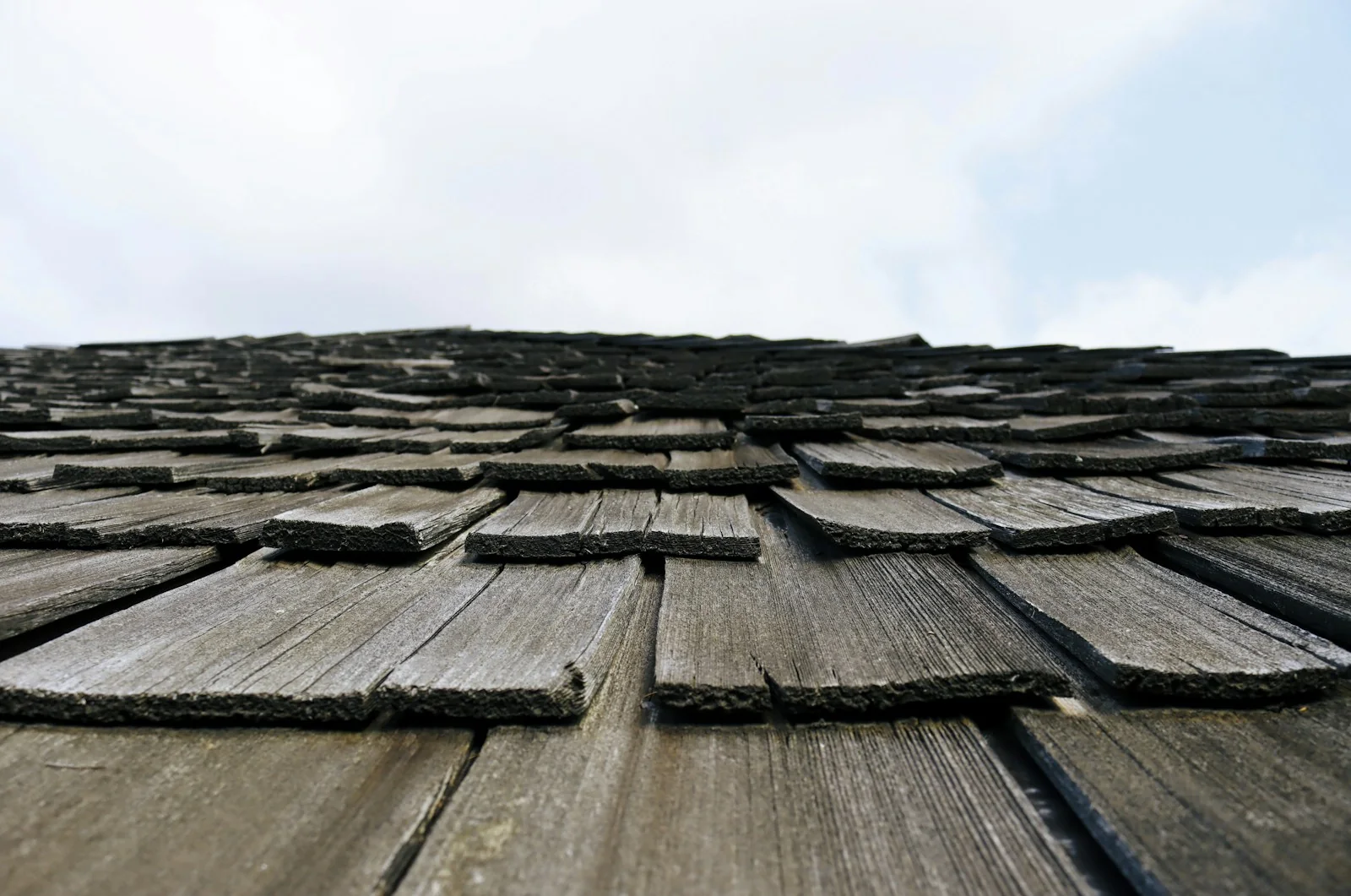
Curling, cupping, clawing and buckling are different shapes
Curling commonly describes an edge or corner moving out of plane. Cupping and clawing refer to different directions of distortion within individual shingles. Buckling often looks like a pronounced raised line or wrinkle through courses rather than one lifted corner. Lifting from wind or an unsealed tab has yet another appearance: an edge can flutter or fail to lie flat because of adhesion or fastening. InterNACHI documents distinctions between these visible conditions.
Take a safe photograph that shows the wider slope and the relative location of the distortion. Does it follow a line from eave to ridge or follow deck panel edges? Does every shingle in one sun-exposed plane show similar behavior? Did it appear on a new installation immediately or develop over many seasons? The shape and timing narrow the mechanisms.
Why older asphalt shingles curl
Asphalt roofing changes with weather exposure. As materials age and the asphalt becomes less flexible, individual shingles can deform, crack and lose their seal. Repeated temperature changes, sun exposure and material characteristics may contribute. A brittle, curled tab may fracture when someone tries to lift it for a patch. The key inspection question is not the age printed on a warranty but whether surrounding material still accepts a reliable repair.
If curls appear broadly across several roof planes, ask the roofer to check adhesion, cracks and other aging signs such as bare granular patches. The more widespread the changes, the harder a localized shingle replacement may be to integrate without disturbing neighboring brittle material. A few curled tabs around one detail are different from systemic distortion.
Buckling from roofing underlayment and deck movement
ARMA's technical bulletin explains that buckles can occur when the roof deck moves or when moisture distorts underlayment beneath shingles. The visible roofing telegraphs the uneven material below. New shingles placed over wet felt, uneven sheathing or improperly prepared deck joints may show wrinkles that persist even though the shingle itself was new. A contractor should not simply press the bump down and claim the substrate was corrected.
Inspectors need to know whether the ridge follows a decking joint, whether the underlayment was exposed to weather before covering and whether a particular area feels structurally sound. The appropriate remedy may involve removing affected shingles, correcting the underlying moisture or deck defect and reinstalling compatible roofing. Do not assume every new-roof wrinkle will disappear during the next warm day.
Wind-lifted shingles and failed seal strips
Architectural shingles have manufacturer-specific seal strips and nailing zones. Wind can exploit an unsealed edge, but a tab that has not bonded can also result from installation timing, temperature, debris or fastening errors. A lifted edge may catch more wind and gradually crease. Look for displacement, missing corners, failed adhesive and fasteners that are high, underdriven or overdriven. Owens Corning describes why correctly seated nails and the specified nail placement matter.
Do not treat caulking down any loose tab as a universal repair. Some products allow qualified hand-sealing under defined conditions, while damaged or creased shingles may need replacement. Check the exact manufacturer's instructions; adding adhesive indiscriminately can trap water or conflict with a warranty. A technician should explain whether the issue is primarily material distortion, poor adhesion or improper fastening.
Can attic moisture or ventilation cause ripples?
An attic can experience moisture when warm interior air leaks into cold roof cavities or mechanical exhaust terminates improperly. Excess moisture may affect roof decking, fastener holding strength or underlayment. Ventilation is relevant to the whole roof assembly but is not an automatic cause of every curled shingle. A professional should examine roof geometry, intake and exhaust paths, air sealing, insulation and whether there is observable wet wood.
The repair may require another qualified trade for ducts or air sealing. Adding a ridge vent alone does not prove that moisture has been controlled. If staining appears in dry winter weather, check for condensation rather than assuming an exterior leak. A defensible roof diagnosis explains the observed pathway and identifies which parts of the proposed fix are roofing work.
Why a new roof can look uneven immediately
A fresh installation may reveal deck joints that were previously hidden, uneven substrates or manufacturing bundle distortion. GAF publishes a technical note on bundle distortion, while ARMA addresses underlayment and decking buckles. These mechanisms have different consequences and remedies. A contractor should document whether a visible ridge is a temporary material shape, a persistent installation defect or an uneven roof structure. Avoid a blanket promise that sunshine will flatten every wavy area.
Ask for the installed shingle product, pre-installation deck photographs, underlayment details and post-installation photos. If the installer agrees the appearance is abnormal, get the follow-up plan in writing. Do not allow destructive tests solely to satisfy a cosmetic concern without discussing possible damage and warranty implications.
What Norwalk weather changes about the diagnosis
Connecticut experiences cold-season nor'easters as well as warm, humid summers. These conditions can reveal different problems: wind may lift a poorly sealed shingle edge, while changing moisture and temperature may reveal movement in underlying wood. NOAA's state climate summary confirms that nor'easters bring precipitation and strong winds. But the existence of such weather does not identify the cause on one roof.
In East Norwalk and Rowayton, ask how a roof face is oriented relative to prevailing storm exposure; in the wooded neighborhoods around Cranbury or Silvermine, ask whether shading, branches and drying conditions affect the assembly. Those are inspection questions, not claims that properties in those neighborhoods commonly have defective roofs. A roofer must examine the exact property and its installation history.
Which distortions are urgent?
A raised shingle edge that has torn or exposes fasteners may allow water entry during the next wind-driven storm. Broad shingle cracking or significant loose material also warrants timely inspection. A long depression, sagging deck or springy roof surface is a more serious structural concern; do not walk on it and see the separate sagging-roof guide. Minor appearance variations with intact roofing may be less urgent, but photographs and product-specific inspection are still useful.
If water is actively entering near electrical fixtures or a ceiling looks unstable, protect occupants and contact appropriate emergency professionals. No one should go on a wet, icy or steep roof to check a corner. A careful report can distinguish visible material distortion from confirmed water entry.
A scope that solves the cause rather than hiding the shape
For one damaged tab on a serviceable asphalt roof, a qualified professional might replace individual shingles and verify underlayment and adjacent seal strips. For underlayment buckling, the affected courses may need to be lifted so the underlying material can be corrected. For inadequate deck support, larger construction repairs may be necessary. The estimate should state what is removed, what is reinstalled and what remains outside the work scope.
Ask for a documented diagnosis, material compatibility, wind-fastening specifications and a written workmanship warranty. Repeatedly gluing the same lifted edge while moisture persists beneath it is not a robust plan. Equally, a small isolated defect should not become automatic justification for replacing sound roof planes.
Questions to ask a roofer about curling, lifting or buckling
Ask whether the pattern points to shingle aging, a failed seal, fastener placement, wet underlayment or roof-deck movement. What observation confirms the proposed cause? Will the contractor need to open shingles to check sheathing? What photograph or moisture finding would change the scope? Are the adjacent shingles pliable enough for local replacement without breakage? These answers determine whether a repair can be durable.
If the contractor recommends a whole reroof, ask for the evidence of widespread failure across roof planes and a comparable limited-repair alternative when feasible. Request the manufacturer's exact product guidance, not a generic claim that all lifted shingles behave the same. Roofing Pros can be reached by phone, but the operating contractor's credentials and scheduling should be confirmed before authorizing work.
roof shingles curling: a symptom-to-next-step comparison
| What you notice | Possible meaning | Useful next step |
|---|---|---|
| Corners curling upward over many years | Material aging or weathering | Check brittleness and extent |
| Raised wrinkle tracing a roof-deck seam | Deck movement or underlayment buckling | Inspect substrate and moisture history |
| One loose tab after wind | Unsealed edge, damage or fastener issue | Inspect nail zone and crease |
| New roof looks wavy after installation | Multiple possible substrate/product issues | Obtain installer and manufacturer assessment |
| A whole roof plane sags or flexes | Potential deck or framing hazard | Keep off roof; assess structure |
This table narrows the investigation; it cannot diagnose an uneven roof from a photograph. Deck seams, shingle courses and individual fasteners need to be located on site.
Questions Norwalk homeowners ask
Are curling shingles an emergency?
An isolated curl may not be immediate failure, but a torn or lifted edge exposed to wind and water warrants timely professional assessment.
Will heat flatten roof shingles that are buckling?
Not necessarily. Buckling from wet underlayment or moving decking requires identifying and correcting its underlying cause.
Can you glue down lifted shingles?
Only where the specific product and observed condition permit a qualified repair. A creased or damaged shingle or bad fastener may require replacement.
Why is my new roof wavy?
Possibilities include decking irregularity, wet underlayment or product deformation. A documented installer inspection should determine which.
Does poor attic ventilation curl shingles?
Attic moisture and heat can affect a roof assembly, but they do not prove why a particular shingle is deformed. Inspect the actual system.
Trace the shape before agreeing to a repair
A fairly straight ridge following a deck-panel seam is a different clue from an irregular wrinkle that crosses several shingle courses. ARMA's buckling guidance distinguishes wood-deck movement, wrinkled underlayment and isolated obstructions. A corner lifted by wind may be a failed seal or incorrectly placed fastener rather than a moisture wrinkle.
Ask for a photograph that includes the entire roof slope and another that relates the raised area to a course, seam or penetration. Ask whether neighboring shingles are still flexible enough to be lifted for a limited repair. A roofer who says every new-roof ripple will disappear in sunshine should be able to explain why. Conversely, a single loose corner does not by itself justify replacing sound roof planes.
When the roofline itself appears depressed rather than just the surface courses, roof-deck or structural evaluation becomes more urgent. These distinctions matter after a reroof because different causes may require different trades and warranty responses.
Technical sources and verification
Research basis: ARMA's technical discussion of buckling, inspection descriptions and manufacturer fastener instructions. No site visit or warranty decision is represented here.
How to discuss the roof warranty after a new-roof distortion
If an installation is relatively new, obtain the signed contract, exact shingle product and any manufacturer or contractor workmanship warranty. Identify whether a problem was visible on completion photographs or emerged later. A product warranty may address a defect in the shingle while a separate workmanship agreement concerns how it was installed. Neither document automatically covers every deck or attic condition.
Ask the installer to state the suspected cause and whether the proposed remedy fits the actual warranty. Keep dated images and avoid authorizing destructive exploratory work without first discussing who pays and which surfaces will be restored.
Can one distorted roof plane be repaired without replacing the others?
Sometimes. A localized raised seam or an isolated wind-lifted tab may be repairable while adjacent roofing remains sound. The deciding factors include material age, ability to lift old shingles without tearing them, deck suitability and whether a new flashing or underlayment transition can be installed correctly. Widespread brittle curling is a different problem from a narrow buckled strip after one installation event.
Ask the contractor to compare a narrowly scoped repair with the larger proposal and identify why each would succeed or fail. This protects the homeowner from both endless patches and an unnecessary roof-wide replacement.